 Trade Buddy
How to Create a Trading Plan You'll Stick To
Build a trading plan short enough to follow every day: define your edge, set your risk rules, run a pre-trade checklist, and review it each week so it sticks.

A trading plan you do not follow is a wish with a spreadsheet attached. Most plans fail not because the rules are wrong but because there are too many of them to remember at 9:31 in the morning, when a candle is ripping and your pulse is up. The fix is not more discipline. The fix is a trading plan short enough to read in a minute and concrete enough to obey, so the rules win the argument with your impulses.
What goes in a trading plan (and what to leave out)
A working trading plan covers six things and nothing else:
- The markets you trade: the specific symbols or instruments, not “stocks” in general. Say “EUR/USD and GBP/USD” or “S&P 500 futures during the New York session.”
- The setups you take: the one or two patterns you have an edge in, written so a stranger could spot them.
- Entry and exit rules: where you get in, where your stop sits, and how you take profit.
- Risk rules: how much you risk per trade, your daily stop, and your max trades per day.
- Your routine: what you do before the open, during the session, and after the close.
- Your review cadence: when you sit down with your journal and grade yourself.
That is a one-page document. A 20-page plan reads like a textbook and gets filed away unread. One page lives on your desk and in your head. If a rule is not specific enough to check yes or no in real time, it is not a rule, it is a mood.
| Vague wish | Testable rule |
|---|---|
| ”Trade when the trend is strong" | "Only go long when price is above the 200 EMA on the 1-hour chart" |
| "Don’t risk too much" | "Risk 1% of the account per trade, hard stop" |
| "Cut losers fast" | "Exit at the stop, no widening it, ever" |
| "Don’t overtrade" | "Three trades per day, then I’m done” |
Write your edge in one sentence
Your edge is the reason you expect to make money over a hundred trades. If you cannot state it in one if-then sentence, you do not have one yet, you have a hunch.
The format stays the same every time: if [these conditions], then I [enter this way], with [this stop] and [this target]. Two concrete examples:
- Pullback long: if price is above the 200 EMA and pulls back to the 20 EMA on the 15-minute chart and prints a higher low, then I buy the break of that candle’s high, stop below the swing low, target two times the risk.
- Opening range break: if the first 15-minute range is under half the average daily range, then I buy the break of the range high, stop at the range midpoint, target the prior day’s high.
You do not need ten setups. You need one or two you can recognize in a half-second and trade the same way every time. The narrower the edge, the easier the plan is to follow, and the cleaner the data you collect on whether it pays. Add setups later, once the first one has a track record.
Before a setup earns a slot in your plan, give it a sample. Fifty to a hundred trades, logged honestly, tells you whether the edge is real or whether you ran hot for a week. Three winning trades is a coincidence, not a strategy, and a plan built on three trades will hurt you the moment the market changes its mind.
Risk rules that keep you in the game
Edge makes money over time. Risk rules decide whether you are still around to collect it. These four lines do most of the work:
- Per-trade risk: a fixed percentage of the account, usually 0.5% to 2%, the same on every trade. This is where position sizing turns a percentage into an exact lot size or share count.
- Daily loss limit: the dollar or percent number that ends your day. Hit it and you are done, win-back attempts included.
- Max trades per day: a hard count. Most overtrading happens after the plan was already satisfied.
- No-trade conditions: news minutes, the first five minutes of the open, days you slept badly, or any setup that is not on your list.
Write the dollar figures next to the percentages. “1% on a $5,000 account is $50 of risk” is a number you can act on at speed; staring at “1%” alone forces you to do math while the price moves.
The daily loss limit is the rule that saves accounts, because it interrupts the spiral before it becomes a revenge trading session. One bad trade is a cost of doing business. Six bad trades chasing the first one is how a green week turns red.
The five-box pre-trade checklist
Right before you click buy, you run a checklist. Five boxes, no more, each a yes-or-no question:
- Is this one of my setups, exactly as written?
- Is my stop placed and my size calculated for my fixed risk?
- Is my reward at least twice my risk?
- Am I under my trade count and above my loss limit for the day?
- Is there any news or event that voids this trade?
Five yeses and you take it. One no and you pass. The checklist is boring on purpose. It puts a small gap between the urge and the order, and that gap is where discipline lives.
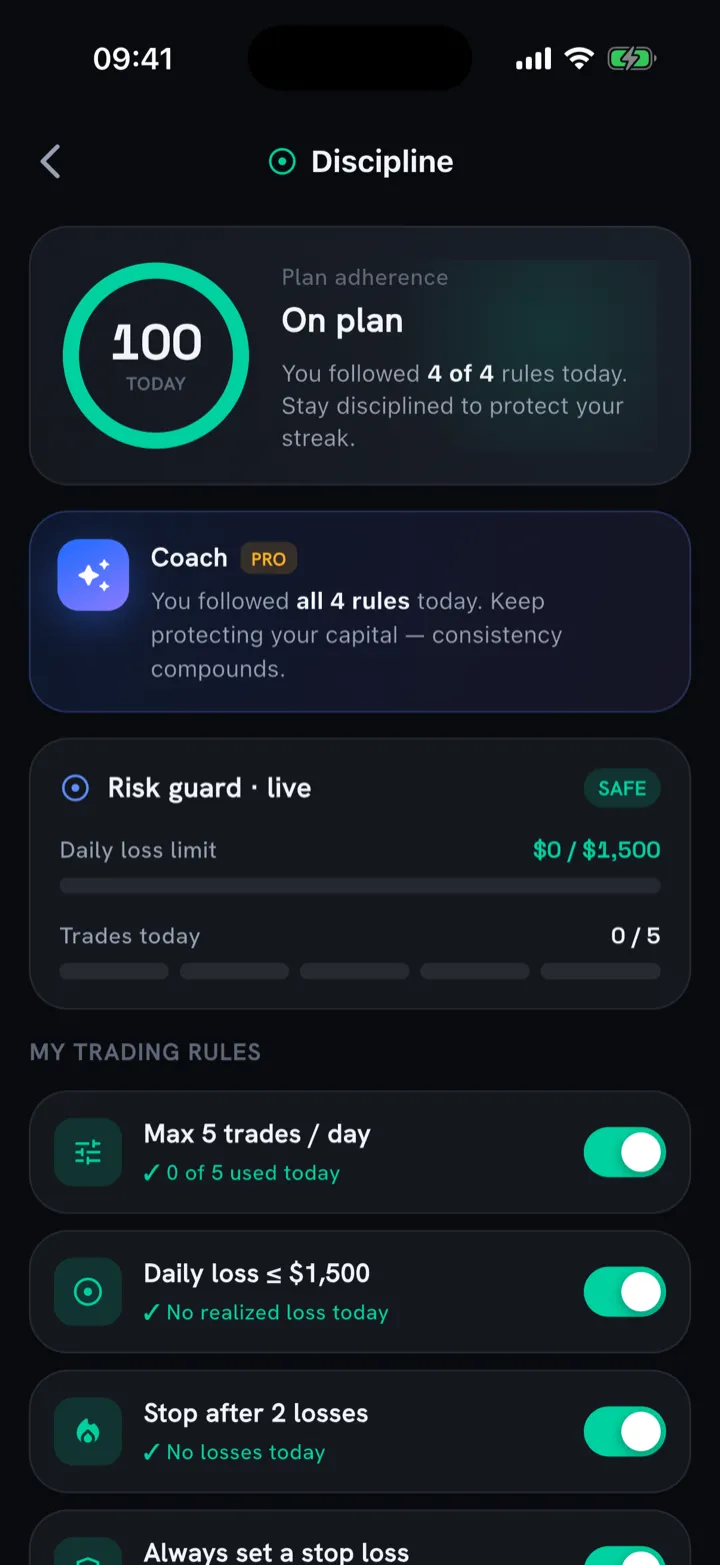
Keeping the checklist next to your journal means you grade each trade against the same rules you traded by, instead of inventing a justification after the fact.
The weekly review that makes the plan stick
A plan without a review loop drifts. Once a week, sit down with your trading journal and ask narrow questions:
- How many trades followed the plan, and how many were off-script?
- Did the off-script trades make or lose money? They usually lose, and seeing it in numbers kills the habit.
- Which setup is carrying your results, and which is bleeding?
- Did you respect your daily loss limit every day?
Track one more number while you are there: your plan-adherence rate, the share of trades that passed all five checklist boxes. When that figure climbs, your results tend to follow. When it slips, you already know the review will be ugly before you open the app.
Then look at the numbers that tell you whether the edge is real. The metrics that matter, win rate, average win versus average loss, expectancy, and R multiple, separate a plan that works from one that only feels good. A PnL calendar layered on top shows whether your green days cluster on certain weekdays or setups, which often points straight at the part of the plan to cut.
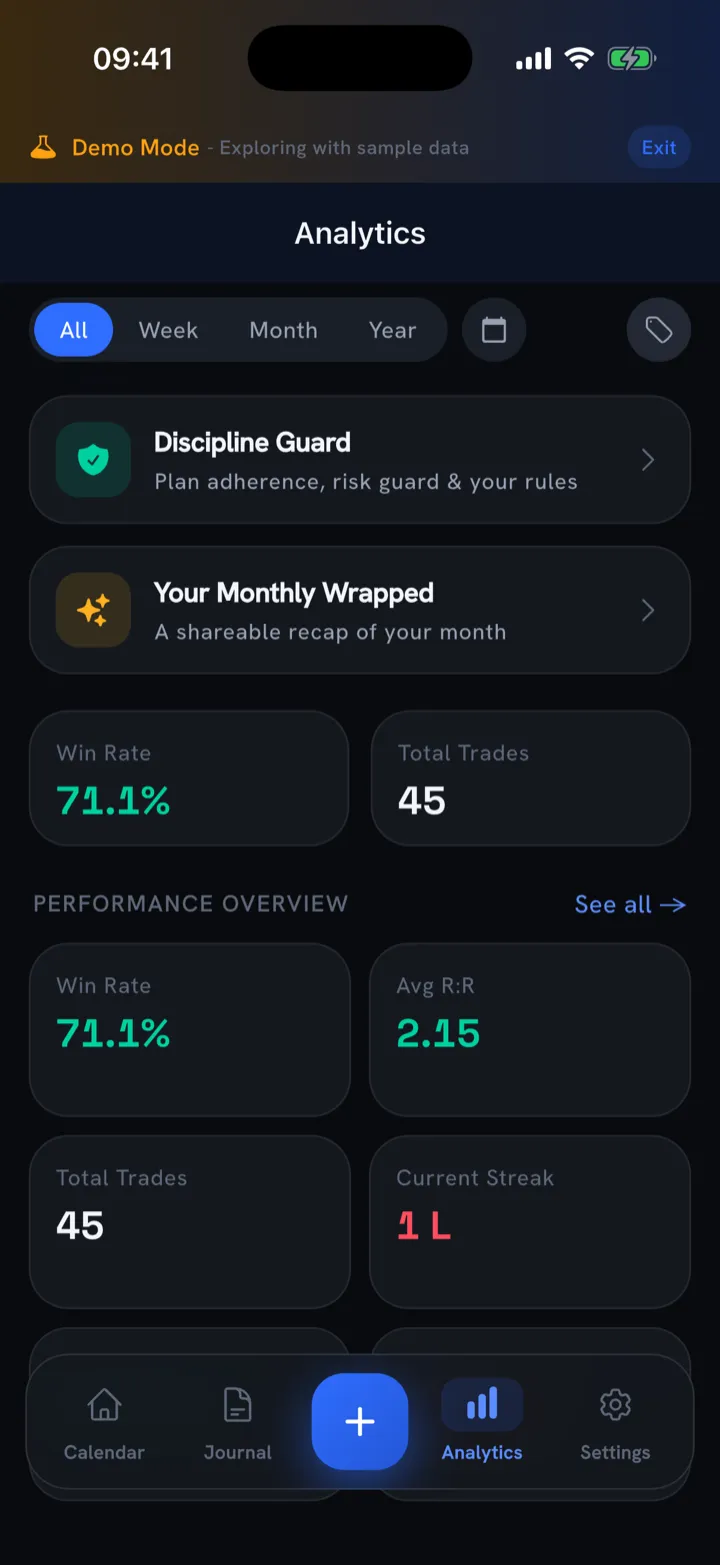
The review is also where you change the plan. Not mid-trade, not mid-day, only here, with data in front of you. Change one variable at a time so you can tell what moved the result, then trade the new version for a few weeks before touching it again.
Trading plan mistakes that quietly kill accounts
The same four failures show up again and again:
- Too vague: rules you cannot grade in real time. “Buy strength” is not a plan, it is a vibe.
- Too complex: twelve setups, six indicators, conditions you cannot hold in your head. Complexity feels thorough and trades terribly.
- Never reviewed: the plan was written once and never tested against results, so bad rules survive for months.
- No risk cap: no per-trade limit, no daily stop. One bad session erases a month, and the plan gets blamed for what missing risk rules did.
Notice that three of the four are about following and reviewing, not about the setups. The entry is the part traders obsess over and the part that matters least.
How Trade Buddy keeps your plan honest
Trade Buddy is a free iOS trading journal built to close the loop between the plan you wrote and the trades you took. You log a trade in seconds, or import your history straight from a screenshot of MT4, MT5, cTrader, or TradingView, so the record matches reality instead of memory.
From there, the analytics show win rate, green days, average win and loss, expectancy, R multiple, and max drawdown, each with a plain-English explainer, so your weekly review takes minutes instead of an evening. Your data stays on device, with no account required. It is free forever to start, and you can compare deeper plans on the pricing page when you want more.
The bottom line
A trading plan is only as good as your willingness to follow it, so make it short, make the rules testable, and review it every week. None of this is financial advice, and no plan removes risk. But a one-page plan you obey beats a brilliant one you ignore. Start logging your trades against your rules today. Get Trade Buddy free on the App Store.
Frequently asked questions
What should a trading plan include?
A trading plan should include the markets you trade, the one or two setups you have an edge in, your entry and exit rules, your risk rules (per-trade risk, a daily loss limit, and a max trade count), your daily routine, and your review schedule. Keep it to a single page so you can read it in under a minute and follow it under pressure.
How do I stick to my trading plan?
You stick to a trading plan by making it short, testable, and visible. Run a five-box pre-trade checklist before every entry so each trade has to earn its place. Set a daily loss limit that ends your session automatically, and review your journal weekly to see where you went off-script. Discipline comes from fewer, clearer rules, not willpower.
How long should a trading plan be?
One page. A trading plan needs to fit the markets you trade, your setups, entry and exit rules, risk limits, routine, and review cadence, and all of that fits on a single sheet. Long plans feel thorough but go unread when a trade is moving fast. If you cannot recall your rules from memory, the plan is too long to follow.
What is the difference between a trading plan and a trading strategy?
A strategy is one setup with its entry, stop, and target, the if-then logic of a single trade. A trading plan is the wider container: which strategies you run, how much you risk, when you trade, what stops you for the day, and how you review results. You can hold several strategies inside one plan, but the plan is what governs your behavior.