 Trade Buddy
Win Rate vs. Risk-Reward: The Trading Metrics That Actually Matter
Win rate alone lies. Learn the trading metrics that actually predict profit: expectancy, profit factor, drawdown, recovery factor, Sharpe and Sortino.

Most traders judge themselves by one number, and it’s the wrong one. The trading metrics that actually predict whether your account grows have very little to do with how often you’re right. A 40% win rate can build wealth while a 70% win rate quietly bleeds an account to zero, and once you understand why, you stop chasing the feeling of being correct and start measuring the thing that pays.
The metrics that follow fix that blind spot. Each one earns its place by telling you something win rate alone can’t.
Why win rate alone lies to you
Win rate is the percentage of your trades that close in profit. It feels like the headline stat, which is exactly why it’s dangerous. It says nothing about how much you win when you win, or how much you lose when you lose.
Picture two traders over 100 trades each:
- Trader A wins 70% of the time, but every win is $50 and every loss is $200.
- Trader B wins 40% of the time, but every win is $300 and every loss is $100.
Trader A nets: (70 × $50) - (30 × $200) = $3,500 - $6,000 = -$2,500. Trader B nets: (40 × $300) - (60 × $100) = $12,000 - $6,000 = +$6,000.
Same number of trades. The “worse” win rate prints money; the “better” one goes backward. Win rate only becomes meaningful when you pair it with the size of your wins and losses. That pairing has a name.
Expectancy: the number that ties win rate and risk-reward together
Expectancy is the average amount you can expect to win (or lose) per trade over a large sample. It’s the single most useful number in your trading metrics, because it folds win rate and risk-reward into one figure.
The formula:
Expectancy = (Win % × Average Win) - (Loss % × Average Loss)
Run it on Trader B from above:
(0.40 × $300) - (0.60 × $100) = $120 - $60 = $60 per trade
A positive expectancy means the system makes money on average. A negative one means it loses, no matter how good a single week looks. Multiply expectancy by your number of trades and you get a rough forecast: 200 trades at $60 expectancy is roughly $12,000 of edge, before you factor in variance.
Two things to remember:
- Expectancy needs a sample. Twenty trades tell you almost nothing. A few hundred start to tell the truth.
- Expectancy assumes consistent sizing and behavior. One revenge trade at 5x normal size can swallow weeks of edge. If that pattern sounds familiar, you need a system rather than willpower. See how to stop revenge trading.
Risk-reward sets your break-even bar
Risk-reward (R:R) is the ratio of your average win to your average loss. Trader B risked $100 to make $300, a 3:1 ratio. The higher your R:R, the lower the win rate you need to stay profitable. The math is clean:
| Risk-Reward | Break-even win rate |
|---|---|
| 1:1 | 50% |
| 1.5:1 | 40% |
| 2:1 | 33% |
| 3:1 | 25% |
| 4:1 | 20% |
At 3:1, you can be wrong three out of four times and still break even. This is why disciplined traders obsess over letting winners run and cutting losers fast. It pushes the break-even bar down to where a modest win rate clears it.
Profit factor: gross wins vs. gross losses
Profit factor is the total money won divided by the total money lost across all your trades.
Profit Factor = Gross Profit ÷ Gross Loss
Trader B again: gross profit of $12,000 ÷ gross loss of $6,000 = a profit factor of 2.0. Every dollar risked returned two.
Quick read:
- Below 1.0: the system loses money.
- 1.0 to 1.3: marginal. A thin edge that fees and slippage erase easily.
- 1.5 to 2.0: a solid, tradable edge.
- Above 2.0: strong, but double-check your sample isn’t tiny or skewed by one monster trade.
Profit factor and expectancy describe the same edge from two angles. Expectancy is per-trade dollars; profit factor is a ratio. Track both. When they disagree, you usually have one outlier trade distorting the picture.
Average win, average loss, and consistency
Your average win and average loss are the raw inputs behind everything above, and watching them over time exposes leaks the summary numbers hide.
- If your average loss is creeping up, you’re holding losers too long or moving stops.
- If your average win is shrinking, you may be cutting winners out of fear.
- A widening gap between your largest loss and your average loss is a red flag for position-sizing discipline.
Consistency matters more than a perfect ratio. A system with predictable average wins and losses can be tuned. One where every trade is a different size and a different idea can’t be measured at all, because there’s no pattern to improve. That’s the real argument for journaling every trade, covered in depth in our guide to keeping a trading journal that improves results.
Max drawdown and recovery factor: surviving the bad stretch
Edge is worthless if a losing streak ends your account before the math plays out. Two metrics measure survival.
Max drawdown is the largest peak-to-trough drop in your account, usually shown as a percentage. If you grew to $12,000 and fell to $9,000 before recovering, that’s a 25% drawdown. It answers the question that keeps real traders honest: how bad did it get? A system with great expectancy and a 60% drawdown is, for most people, untradable. You’ll quit at the bottom.
Recovery factor measures resilience: your net profit divided by your max drawdown.
Recovery Factor = Net Profit ÷ Max Drawdown
A net profit of $6,000 against a max drawdown of $1,500 gives a recovery factor of 4.0, so the system earned four times the pain it inflicted. Higher is better. A recovery factor under 1.0 means your worst drawdown was larger than everything you made, which is a system worth retiring.
Sharpe and Sortino in plain English
These two come from professional portfolio management, but the idea is simple: they measure return relative to how bumpy the ride was.
- Sharpe ratio asks how much return you earned for each unit of total volatility. A steady $60-per-trade grind scores high; the same average profit delivered through wild swings scores low. Higher Sharpe means smoother, more repeatable returns.
- Sortino ratio is Sharpe with a fix. Sharpe penalizes all volatility, including big winning days, which is odd because nobody complains about upside. Sortino only counts downside volatility. For traders it’s often the more honest number, because it stops punishing you for outsized wins.
You don’t need to calculate these by hand. Two systems with identical returns are not equal if one got there through stomach-churning swings. Sharpe and Sortino put a number on that smoothness, and smoother systems are easier to size up and stick with.
A worked example: the profitable 40% system
Here’s the full picture for an illustrative system over 100 trades, win rate 40%, risk-reward 3:1. (Numbers are an example to show the relationships, not a promise of returns.)
| Metric | Value |
|---|---|
| Win rate | 40% |
| Average win | $300 |
| Average loss | $100 |
| Risk-reward | 3:1 |
| Expectancy | $60 per trade |
| Profit factor | 2.0 |
| Net over 100 | +$6,000 |
Forty wins and sixty losses. You are “wrong” more often than you are right, and the account still climbs. That is the lesson of trading metrics in one table: stop optimizing to be right, optimize your expectancy.
How Trade Buddy tracks your trading metrics
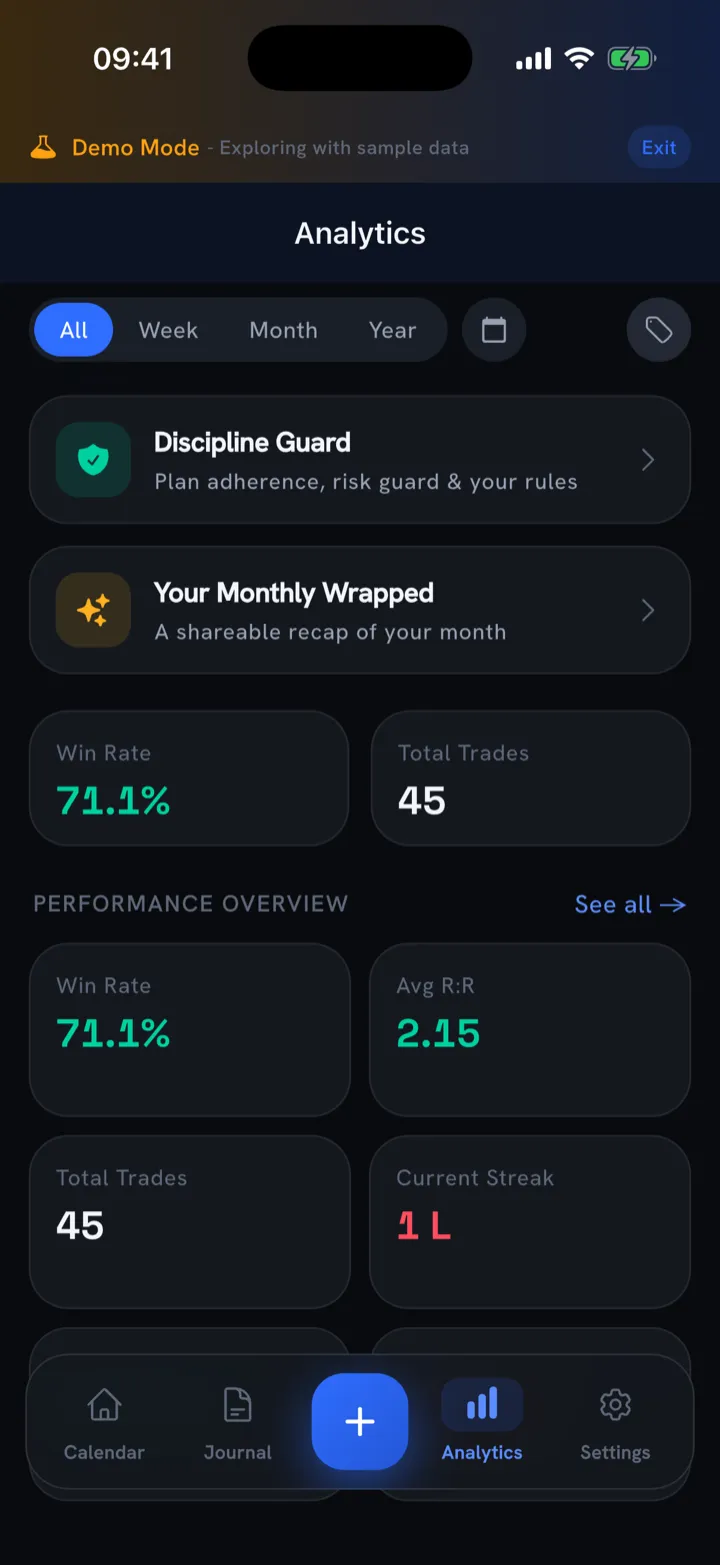
Calculating expectancy, profit factor, and drawdown by hand in a spreadsheet works until it doesn’t, usually around the point you have a few hundred trades and stop updating it. Trade Buddy computes all of these automatically from your logged trades. Sharpe, Sortino, expectancy, max drawdown, and recovery factor each sit on your dashboard with a one-line, plain-English explainer, so you’re never staring at a number you can’t interpret.
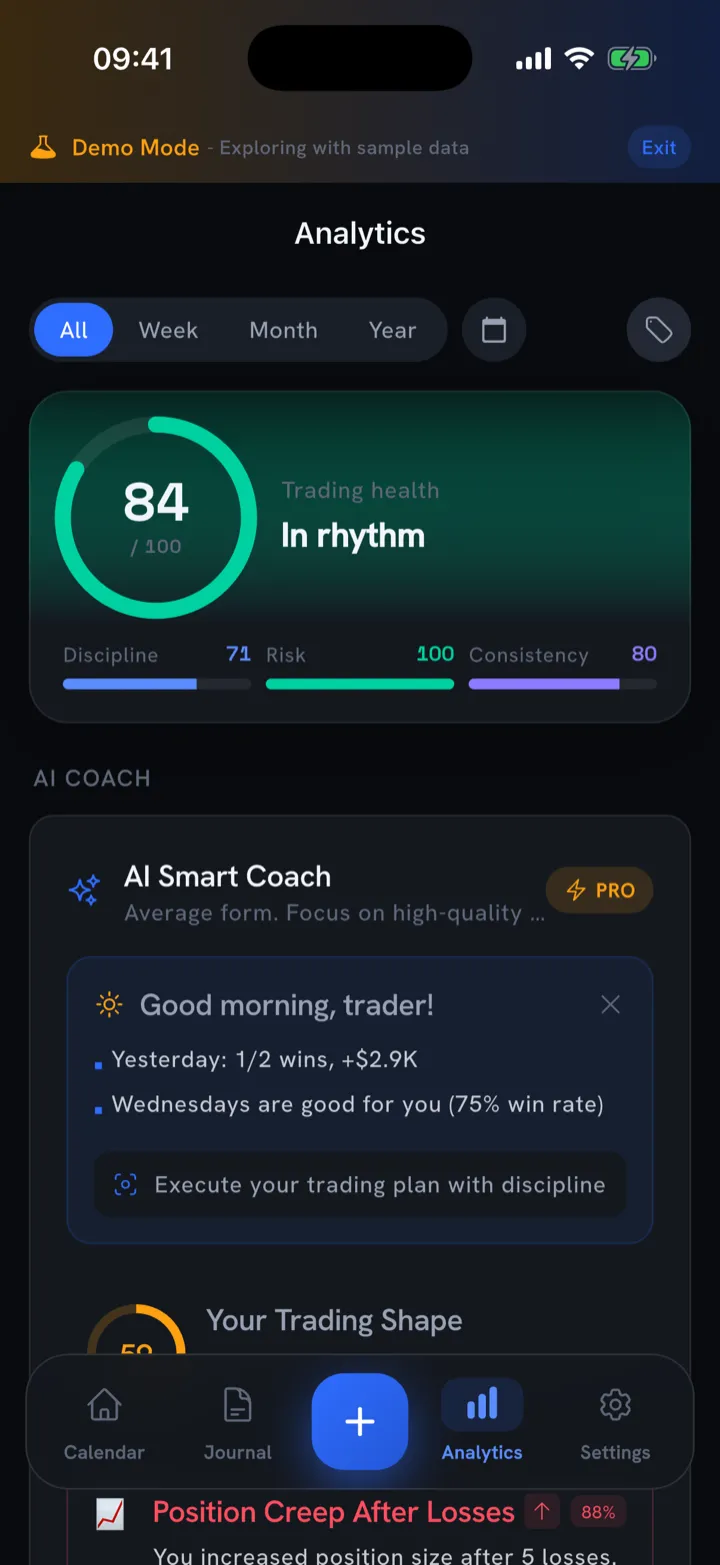
Logging is the part that usually breaks the habit, so it’s built to be fast: quick-log a trade in under five seconds, or snap a screenshot of your MetaTrader or TradingView history and let the app read every fill. If your trades live in MT4 or MT5, our walkthrough on importing MT4 and MT5 trades gets your history in quickly. From there, the color-coded PnL calendar turns months of trades into green and red days you can read at a glance.
It’s free to start, with Pro analytics when you want the deeper metrics. Your trade data stays on your device.
The bottom line
Win rate is the metric that feels best and tells you least. Expectancy is the one that pays. Read your trading metrics as a set: win rate, risk-reward, expectancy, profit factor, drawdown, and the smoothness scores. Together they tell you which setups to keep and which to cut. These numbers are tools for your own honesty, not financial advice. The edge still comes from your discipline.
Start logging every trade and let the numbers show you where your real edge lives. Download Trade Buddy free and watch your trading metrics build from your first entry.
Frequently asked questions
What is expectancy in trading?
Expectancy is the average profit or loss you can expect per trade over a large sample. You calculate it as win rate times average win, minus loss rate times average loss. A positive expectancy means the system makes money on average, while a negative one loses regardless of how good any single week looks. It folds win rate and risk-reward into one figure.
Is win rate a good metric?
Win rate alone is misleading. It tells you how often you win but nothing about how much you win or lose each time. A 40 percent win rate with large winners can be very profitable, while a 70 percent win rate with small wins and big losses can drain an account. Pair win rate with risk-reward and expectancy before you judge a system.
What is a good profit factor?
Profit factor is gross profit divided by gross loss. Below 1.0 the system loses money. Between 1.0 and 1.3 the edge is thin and easily erased by fees and slippage. Between 1.5 and 2.0 is a solid, tradable edge. Above 2.0 is strong, though you should check that the result is not skewed by one unusually large trade.
What is the difference between Sharpe and Sortino?
Both ratios measure return relative to volatility, so they reward smooth, repeatable results. The Sharpe ratio penalizes all volatility, including big winning days, which can unfairly punish a system for large gains. The Sortino ratio counts only downside volatility, so it ignores upside swings. For traders, Sortino is often the more honest number because it does not penalize outsized wins.
How many trades before metrics are reliable?
A small sample tells you almost nothing. Twenty trades are mostly noise, and a single outlier can distort every number. Most traders want at least a few hundred trades before expectancy, profit factor, and drawdown start describing a real edge rather than luck. The metrics also assume consistent position sizing, so erratic bet sizes make any sample harder to trust.