 Trade Buddy
How to Stop Revenge Trading: A Discipline System That Sticks
Revenge trading can blow up an account in an afternoon. Learn why it happens and build a discipline system that holds the line when you can't.
You take a stop-out, feel that hot flush in your chest, and immediately size up to “make it back.” That impulse has a name: revenge trading. It is the single fastest way to turn a normal red day into a blown account, and almost every trader does it before they learn to stop.
The good news: revenge trading is a behavior, not a character flaw. Behaviors respond to systems. A discipline system can interrupt the impulse at the moment it fires, before you give back three winners.
What revenge trading actually is
Revenge trading is taking a trade primarily to recover a loss or soothe the sting of one, rather than because your edge said to take it. The tell is the motive. If the only reason you’re clicking buy is that the last trade hurt, the emotion is in the driver’s seat.
It usually shows up as a cluster of behaviors:
- Sizing up right after a loss to “get it back in one”
- Trading a setup you’d normally skip
- Cutting your normal process: skipping the checklist and the defined risk
- Chasing price into a move that already happened
- Stacking trade after trade with no break in between
One loss is rarely the problem. The spiral that follows is.
Why it happens: loss aversion and tilt
Two forces drive it. The first is loss aversion, the well-documented tendency for a loss to feel roughly twice as painful as an equivalent gain feels good. That asymmetry means a $200 loss creates an urge to act that a $200 win never would. Your brain treats the red number as a wound to close, not a cost of doing business.
The second is tilt, a term borrowed from poker. Tilt is the state where emotion overrides strategy. After a loss or a missed move, your decision-making degrades: your time horizon shrinks and the rational part of your brain goes quiet. You know the trade is bad. You take it anyway. That gap between knowing and doing is tilt.
You cannot think your way out of tilt in the moment. By definition, your thinking is compromised. That’s why willpower fails here and why you need a system that decides for you, in advance, when you’re calm.
The discipline system, layer by layer
A good anti-revenge system has layers, because no single rule survives every emotional state. Each layer catches what the previous one missed.
1. Pre-trade rules you wrote when calm
Before the session, write down what a valid trade looks like. Keep it short enough to actually check:
- The exact setups you’re allowed to take
- Your fixed risk per trade (a fixed percentage, not a feeling)
- Required confirmation before entry
- A one-line invalidation: where you’re wrong and out
The point of pre-trade rules is to move the decision out of the heat of the moment. When the rules are written, a revenge trade becomes obvious: it breaks one of them on its face. You’re no longer arguing with yourself; you’re checking a list.
2. A daily loss limit
This is the most important number you’ll set. A daily loss limit is the maximum you’ll lose in a single session before you’re done. When you hit it, you stop.
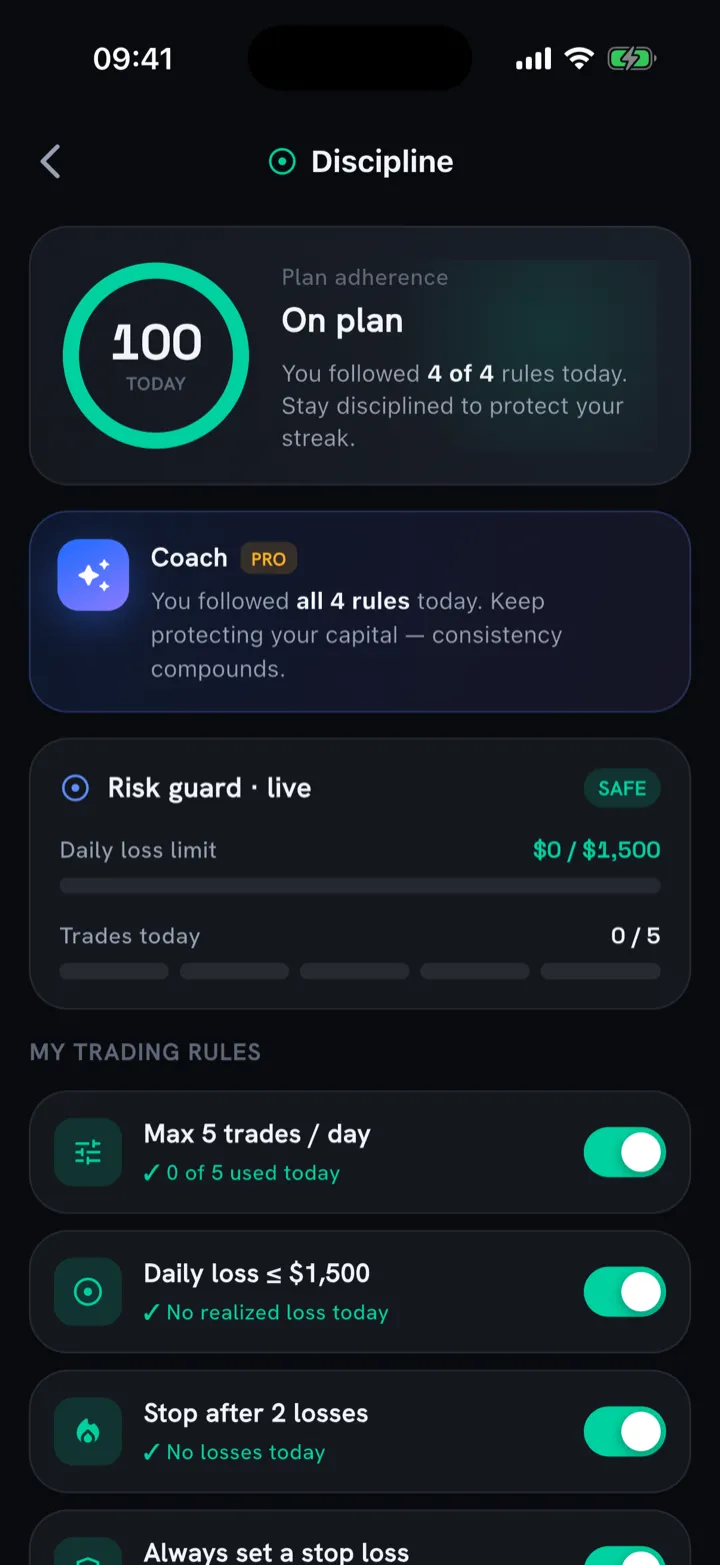
Set it as a fixed amount or a percentage of your account that, when hit, still leaves you completely fine tomorrow. The loss limit exists precisely for the days your judgment is worst. By the time you’ve hit it, you’re often already tilting, so the limit has to be non-negotiable and set in advance.
A loss limit works like a seatbelt. You forget it on every normal day, and it saves you on the one day you crash.
3. A max-trades cap
Revenge spirals are usually about frequency as much as size. A max-trades cap (say, five trades a day) puts a hard ceiling on how many times you can act on impulse. Once you’re capped out, the decision is made for you. This single rule quietly kills the “death by a thousand clicks” version of revenge trading, where no single trade is huge but the cumulative bleed is brutal.
4. A cool-down protocol
This is the layer most traders skip, and it’s the one that directly targets tilt. A cool-down protocol is a pre-defined response to a triggering event, usually a loss or a stop-out streak.
A simple version:
| Trigger | Cool-down action |
|---|---|
| Any full stop-out | Step away from the screen for 10 minutes |
| Two losses in a row | 30-minute break, no charts |
| Hit daily loss limit | Done for the day. Close the platform. |
| Feeling the urge to size up | Cut size in half on the next trade, not double |
The mechanic that matters is time. Tilt fades. Ten minutes away from the screen is often enough for the rational brain to come back online. The cool-down buys time so a temporary brain state can pass.
5. Journaling the emotional state
Log how you felt, not just what you traded. After each trade or each session, note your emotional state in a word or two: calm, frustrated, bored, fearful, vengeful. Over a few weeks, the pattern becomes undeniable. You’ll see, in your own data, that your “frustrated” trades have a far worse expectancy than your “calm” ones.
That feedback loop is what actually changes behavior. It’s hard to keep revenge trading when your own journal shows you it costs you money every single time. If you want a full method for this, see our guide on keeping a trading journal that actually improves your results.
How a plan-adherence score and risk guard help
Rules only work if something holds you to them. Two tools do the holding.
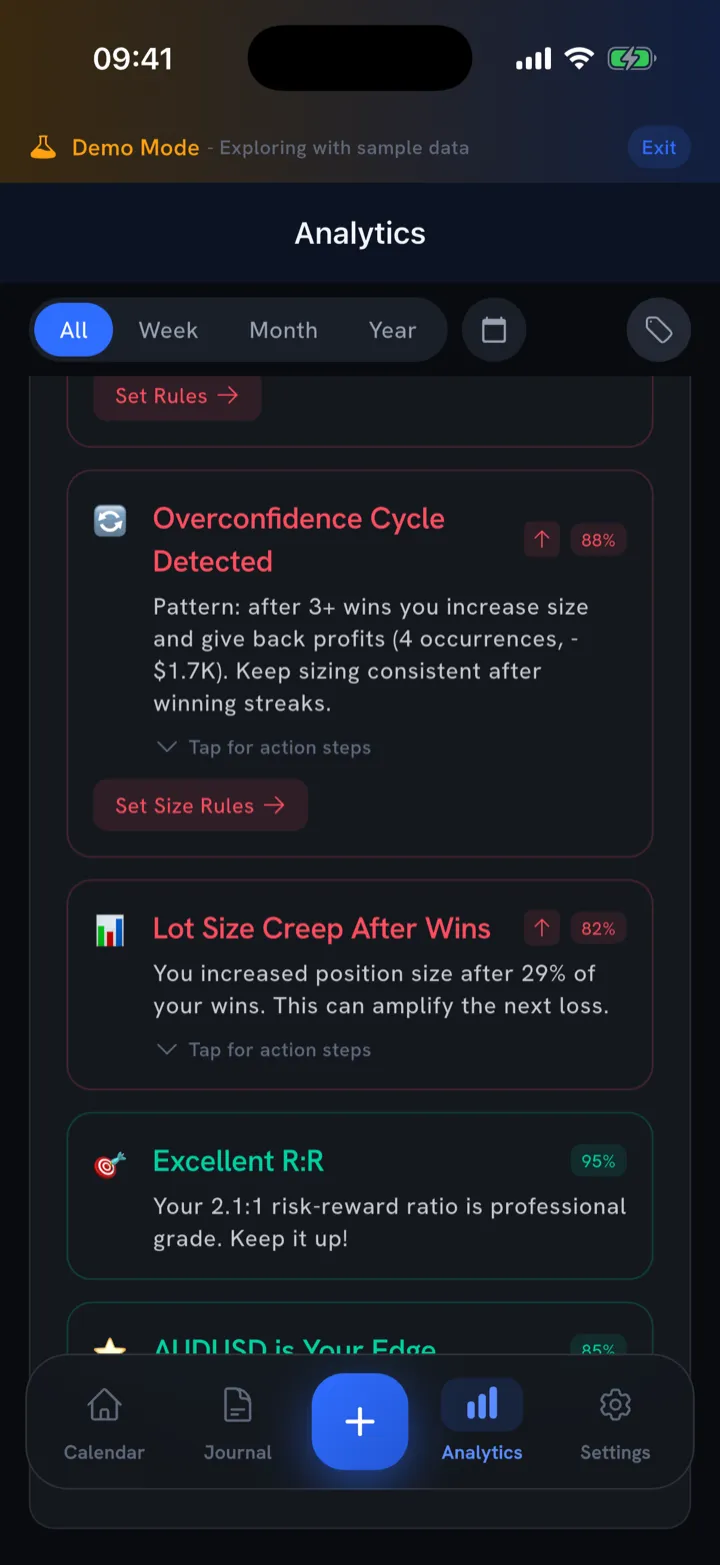
A plan-adherence score grades each day on how closely you followed your own rules, independent of whether you made money. A green day where you broke every rule is a bad day; you got lucky, and luck regresses. A red day where you followed the plan perfectly is a good day; the process was sound. Scoring adherence separately from P&L is how you stop confusing outcome with decision quality. It’s the same reason win rate alone can mislead you about whether you’re actually good. More on that in win rate vs. risk-reward.
A risk guard is the automation layer. Instead of relying on you to remember the loss limit while tilting, the guard tracks your daily loss, your trade count, and your custom rules in real time and warns you the instant you cross a line. It turns a good intention into a live alert at the exact moment you’re most likely to ignore it.
Together they form a loop:
- You set the rules when calm.
- The risk guard watches them while you trade.
- The adherence score grades you when you’re done.
- The journal shows you the emotional cost over time.
- Tomorrow, the rules are easier to follow.
A real-feeling example
Illustrative, not a real account. Maya trades index futures. Her plan: three setups, 1% risk each, four trades max, daily loss limit at 3%.
Tuesday, she takes two clean losses back to back, down 2%. The old Maya would size up on the third to claw it back. Instead, her cool-down protocol kicks in: two losses in a row means a 30-minute break. She walks away.
She comes back calmer, takes one valid setup at normal size, and it works. She ends the day down 1.2%, a small and controlled red day. Her adherence score is a clean 100% because she followed every rule. Three weeks later, her journal shows the trades she didn’t take on tilt would have lost an average of 1.8% each. The system didn’t make her money that Tuesday. It stopped her from turning a small red day into a blown one, and over a year that restraint is what keeps an account alive.
How Trade Buddy fits
Trade Buddy is built around exactly this loop. You set custom trading rules, a daily loss limit, and a max-trades guard, and the discipline layer warns you live when you’re about to cross a line. Each day gets a plan-adherence score and a streak, so following your process becomes its own scoreboard, separate from P&L.
The color-coded PnL calendar makes the pattern visible at a glance: tap any red day and you can see whether you traded the plan or revenge-traded your way there. And because logging a trade (including your emotional state) takes a few seconds, the journal actually gets filled in. If you trade MetaTrader or cTrader, you can even import your history from a screenshot instead of typing it.
A journal shows you your own behavior clearly. It isn’t financial advice, and it won’t take the trade for you. But it will show you, in your own numbers, what revenge trading actually costs, and that’s usually what finally makes it stop.
The bottom line
Revenge trading isn’t beaten by trying harder in the moment, because the moment is exactly when your judgment is worst. You beat it with layers set in advance: pre-trade rules, a hard daily loss limit, a max-trades cap, a cool-down protocol, and a journal that tracks how you felt. Add a plan-adherence score and a risk guard, and the system holds the line when you can’t.
Set your rules, set your loss limit, and let the app enforce them. Start your discipline system in Trade Buddy.
Frequently asked questions
What is revenge trading?
Revenge trading is placing a trade mainly to win back a recent loss or calm the frustration it caused, rather than because your strategy gave a valid signal. The motive is emotional, not analytical. It usually shows up as sizing up after a loss, skipping your checklist, chasing price, and stacking trades with no break between them.
Why do I revenge trade?
Two forces drive it. Loss aversion makes a loss feel about twice as painful as an equal gain feels good, so your brain treats red numbers as wounds to close fast. Tilt, a term from poker, is the emotional state where strategy gives way to impulse. Together they shrink your patience and quiet the rational part of your decision making.
How do I stop revenge trading?
Decide your rules while you are calm, then let a system enforce them. Set a daily loss limit, cap the number of trades per session, and write a cool-down step that pulls you off the screen after a stop-out. Log how you felt on each trade. Reviewing that record shows you what tilt costs, which is what finally changes the habit.
What is a good daily loss limit?
A good daily loss limit is a fixed dollar amount or account percentage that, once hit, still leaves you completely fine to trade tomorrow. Many traders use one to three percent of the account, but the right number is personal. Set it in advance, when your judgment is clear, and treat it as final once the session reaches it.
Does a cooling-off rule work?
Yes, because tilt is temporary. Stepping away for ten to thirty minutes after a loss or a losing streak gives the rational part of your brain time to come back online before you trade again. The break works best when you define it in advance and follow it automatically, so you are not negotiating with yourself in the heat of the moment.