 Trade Buddy
What Is a Good Win Rate in Trading? It's Lower Than You Think
A good win rate is lower than most traders think. See the breakeven math by reward-to-risk, why a 40% win rate still prints money, and how to track yours.

Ask a new trader what a good win rate is and most will say something north of 70 percent. Ask a profitable one and you’ll often hear 40 to 50 percent. The gap between those two answers is where a lot of accounts quietly die. A good win rate is not the highest number you can post. It’s a number that fits the size of your wins against the size of your losses. Chase win rate for its own sake and you end up grabbing tiny profits and nursing big losers, which is exactly backwards.
Win rate is only half a sentence
Win rate is the share of your trades that close in profit. Take 10 trades, win 6 of them, and your win rate is 60 percent. That’s the whole calculation. It says nothing about how much you made on those six or how much you handed back on the four.
That’s why win rate read on its own is close to meaningless. A 60 percent win rate sounds great until you learn the average winner was 20 dollars and the average loser was 80. The number you care about is win rate paired with your reward-to-risk ratio: how big your average win is compared to your average loss. One without the other is half a sentence. For the full set of numbers worth watching, see our guide to trading metrics that matter.
The breakeven math nobody shows you
Every reward-to-risk ratio has a win rate where you break even. Win more often than that and you make money. Win less and you lose, no matter how good the trades felt at the time.
The formula is short. Breakeven win rate equals your risk divided by (risk plus reward). If you risk 1 to make 2, that’s 1 divided by (1 plus 2), which is 33 percent. Here’s how it plays out across common ratios:
| Reward-to-risk | Breakeven win rate | Win rate for profit |
|---|---|---|
| 1 : 0.5 | 67% | above 67% |
| 1 : 1 | 50% | above 50% |
| 1 : 2 | 33% | above 33% |
| 1 : 3 | 25% | above 25% |
Read the middle column as the line in the sand. At 1 to 2, you can be wrong two times out of three and still come out ahead. At 1 to 0.5, where your target is smaller than your stop, you need to win more than two thirds of the time to tread water. That bottom-heavy ratio is where high-win-rate strategies live, and it’s also where a single bad day can erase a month of work. The wider your winners, the lower your win rate is allowed to drop.
Notice why this trips people up. Being right feels good, so the brain treats a high win rate as proof of skill. The market does not pay you for being right, though. It pays you for the gap between your winners and your losers. A trader who is wrong 60 percent of the time can out-earn one who is right 60 percent of the time, as long as the winners are wide enough. Detach your ego from the percentage and you make cleaner decisions about when to hold and when to fold.
A good win rate depends on how you trade
There is no single good number, because win rate is a function of style. Tighter targets win more often and smaller. Wider targets win less often and bigger. Both can be profitable, and both can be ruined by ignoring the trade-off.
- Scalping and mean-reversion: these take frequent, small gains and aim to be right often. Win rates of 60 to 70 percent are normal, paired with a reward-to-risk near or below 1 to 1.
- Trend and breakout trading: these accept being wrong a lot in exchange for outsized winners. A 35 to 45 percent win rate is healthy when winners run 3 or 4 times the size of losers.
- Swing trading: usually lands in the middle, around 45 to 55 percent, depending on how far your targets sit from your entries.
So when someone asks whether their win rate is good, the honest answer is a question back: good compared to what reward-to-risk? A 40 percent win rate is excellent for a breakout trader and a disaster for a scalper clipping 1 to 1.
Your win rate is not fixed, either. The same strategy that wins 55 percent in a trending market can drop to 40 percent when price chops sideways for three weeks. That swing is normal, not a sign the system broke. It is also why a single month tells you almost nothing, and why traders who judge themselves on a 10-trade streak end up ripping apart an edge that was working fine.
A high win rate can still bleed you dry
Here’s the trap that catches confident traders. You can win 80 percent of your trades and still lose money. Picture 10 trades: eight winners at 25 dollars each is 200 dollars. Then two losers at 150 each is 300 dollars. You won 80 percent of the time and you’re down 100 dollars.
That’s the shape of an account that cuts winners early and lets losers run until they come back. The win rate looks elite on a screenshot. The equity curve points down. It’s also how revenge trading hides: you take a quick scalp to feel a win after a loss, padding the percentage while your real risk sits in the position you refuse to close. If that loop sounds familiar, our piece on how to stop revenge trading breaks it down.
Win rate versus expectancy: the number that pays
If win rate is half a sentence, expectancy is the whole thing. Expectancy tells you the average dollars (or R) you can expect per trade, and it folds win rate and trade size into one figure.
Expectancy = (win rate x average win) minus (loss rate x average loss)
Run the 80 percent trader through it: (0.8 x 25 dollars) is 20 dollars, and (0.2 x 150 dollars) is 30 dollars. Expectancy is 20 minus 30, or negative 10 dollars a trade. The high win rate was a mirage. Now the breakout trader at 40 percent, winning 300 dollars on average and losing 100: (0.4 x 300) is 120, (0.6 x 100) is 60, so expectancy is positive 60 dollars a trade. Lower win rate, far better business.
It helps to drop the dollars and think in R, where 1R is the amount you risk per trade. The breakout trader above risks 100 dollars to make 300, so each winner is plus 3R and each loser is minus 1R. Counting in R lets you compare a 10-dollar trade and a 10,000-dollar trade on the same scale, and it stops one oversized position from distorting your read on the whole system.
Positive expectancy is the only thing that makes a strategy worth trading. Once you have it, position size decides how fast it compounds, which is a separate skill covered in how to calculate position size.

How to track yours without fooling yourself
The reason most traders misjudge their win rate is memory. You remember the clean winners and quietly forget the messy scratch trades and the loser you held an extra hour. The fix is mechanical: log every trade and let the math speak.
- Record every close, including the small ones you’d rather not look at.
- Track win rate next to average win and average loss, never on its own.
- Watch the trend over 50 to 100 trades, not over your last 5.
Sample size is the other trap. Five trades is noise. Even a coin-flip strategy can win four in a row and convince you it works, then give it all back over the next ten. You need enough closes for the average to settle, which is why 50 to 100 trades is the floor before you trust any win rate figure. Below that you are reading weather, not climate.
A PnL calendar helps here because it shows your green and red days as a pattern, so one ugly loss can’t hide inside a string of small greens. And keeping a consistent journal, the habit covered in our trading journal guide, is what turns a guess about your win rate into a fact you can act on.
How Trade Buddy puts win rate in context
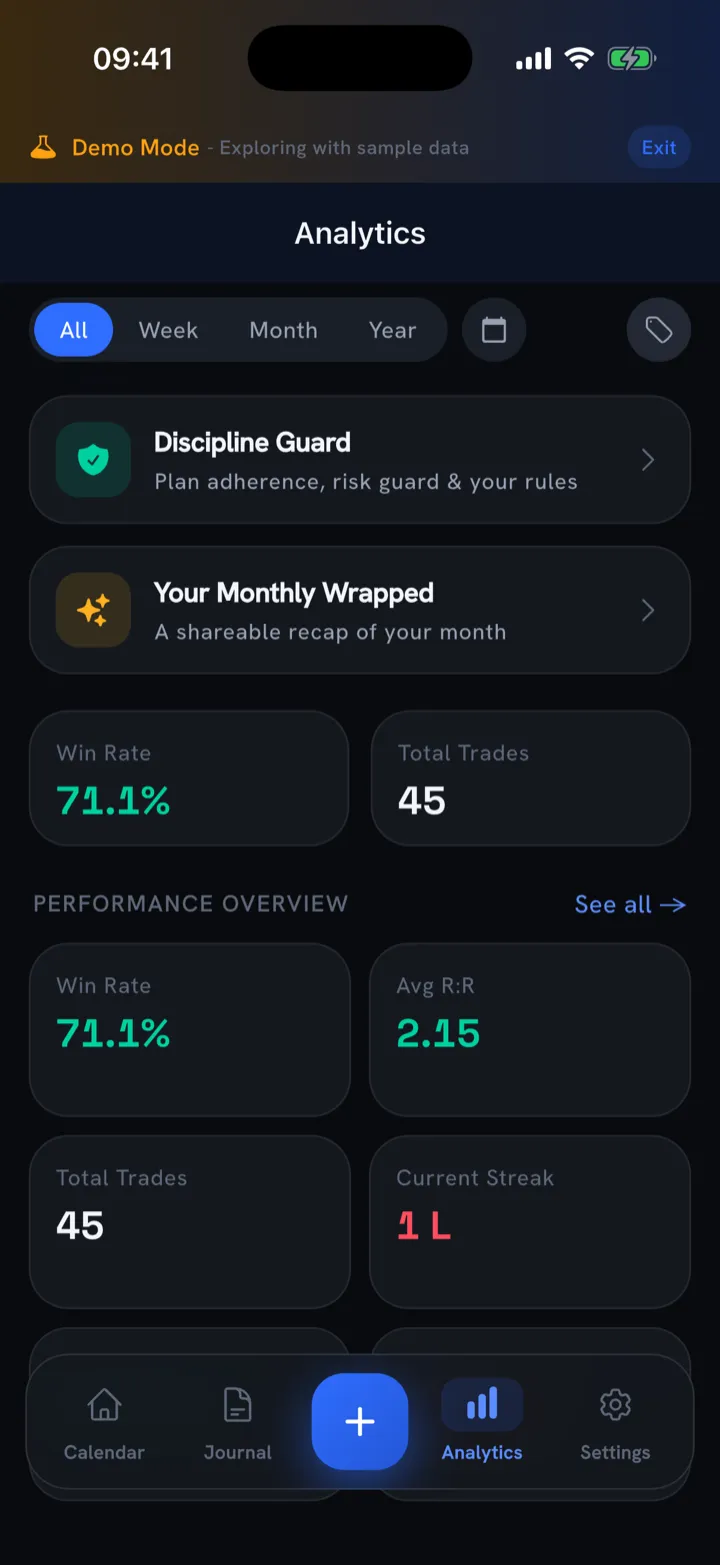
Trade Buddy shows your win rate where it belongs: right next to average win, average loss, R multiple, and expectancy, so you never read the percentage in isolation. The analytics come with plain-English explainers for expectancy, max drawdown, Sharpe and Sortino, and you can import trades by screenshotting your MT4, MT5, cTrader, or TradingView history. Your data stays on device, with no account required. It’s free to start, and you can compare tiers on the pricing page.
The bottom line
A good win rate is whatever clears your breakeven line for the reward-to-risk you trade, and for plenty of profitable traders that’s well under 50 percent. Stop optimizing the percentage and start optimizing expectancy. None of this is financial advice, but the math is the math: log your trades, read win rate beside your average win and loss, and let the numbers tell you the truth. Get Trade Buddy free on the App Store.
Frequently asked questions
What is a good win rate in trading?
A good win rate is any rate that beats your breakeven point for the reward-to-risk you trade. With a 1:2 ratio, breakeven sits near 33 percent, so 45 percent is strong. With a 1:1 ratio you need to clear 50 percent. There is no universal good number; it only makes sense when read next to your average win and average loss.
What is a good win rate for day trading?
For day trading it depends on your edge. Scalpers taking small, frequent profits often run 60 to 70 percent because targets sit close to entry. Momentum and breakout day traders may sit at 40 to 50 percent with much larger winners. Both are good if expectancy stays positive, so judge the percentage against your average win and loss, not in isolation.
Can you be profitable with a 40% win rate?
Yes. A 40 percent win rate is profitable whenever your winners are large enough relative to your losers. At a 1:2 reward-to-risk ratio, breakeven sits near 33 percent, so 40 percent clears it comfortably. Many trend and breakout traders live here, losing more trades than they win while the account still grows because each winner pays for several losers.
Is win rate or expectancy more important?
Expectancy. Win rate alone cannot tell you whether a strategy makes money, because it ignores the size of wins and losses. Expectancy combines both: win rate times average win, minus loss rate times average loss. A positive number means the strategy pays over time. Use win rate as one input into expectancy, never as the final scoreboard.