 Trade Buddy
How to Calculate Position Size (Risk First, Every Trade)
Learn how to calculate position size before every trade: one risk-first formula, worked forex and stock examples, plus how to log size to keep your R honest.
Most traders obsess over the entry. The number that decides whether you survive a bad month is your position size: how much you put on a single trade. Get it right and one loser is a scratch. Get it wrong and one loser undoes ten good trades. Here is how to calculate position size the same way every time, starting from risk instead of from a hunch.
The one formula behind every position size
There is a single equation, and everything else is plugging numbers into it:
Position size = account risk (in dollars) / stop distance per unit
Two pieces. The first is account risk, the dollar amount you are willing to lose if this trade goes against you. You set it as a percent of your balance:
- Account risk = account balance x risk percent. On a $5,000 account at 1%, that is $50. This is the most you lose on the trade, full stop.
The second is stop distance per unit, which is what one unit of the thing you are trading loses if price reaches your stop. A unit is one share, one lot, one contract. Divide your fixed dollar risk by that per-unit loss and you get the number of units to buy or sell.
Notice what this does. You decide the loss first, then the size falls out of it. You never start with “how many shares feels right” and back into the risk later. Risk leads, size follows.
A worked example, start to finish
Say you trade EUR/USD with a $5,000 account.
- Set account risk. 1% of $5,000 is $50. That is your maximum loss on this trade.
- Measure the stop. Your setup puts a stop 20 pips away from entry.
- Find the per-unit loss. One standard lot of EUR/USD moves about $10 per pip. So one lot risked over 20 pips loses 20 x $10 = $200.
- Divide. Position size = $50 / $200 = 0.25 lots.
You enter a quarter of a standard lot. If the stop hits, you lose $50, exactly what you decided. No surprise, no “I didn’t realize it was that big.”
Now a stock example with the same logic. You want to buy a stock and your stop sits $0.50 below entry. Your risk per trade is still $50.
- Per-unit loss = $0.50 per share.
- Position size = $50 / $0.50 = 100 shares.
A hundred shares, and a stop-out costs $50. Different market, different unit, identical arithmetic. Once the formula is muscle memory you can run it in your head before the order ticket is even open.
Fixed percent or fixed dollar?
You can hold your risk steady in one of two ways. Both are valid, and the table below shows the trade-off.
| Approach | How it works | Strength | Weakness |
|---|---|---|---|
| Fixed percent | Risk a set percent of your current balance every trade (say 1%) | Scales down automatically in a drawdown, scales up as you grow | The dollar figure changes every trade, so you recalc each time |
| Fixed dollar | Risk the same dollar amount every trade (say $50) | Dead simple, the number never moves | Does not shrink after losses, so a falling account risks a bigger share each time |
Beginners often do well starting fixed dollar because it removes a step and keeps the math obvious. As your account moves, fixed percent protects you better, because it cuts your size right when a losing streak has already done damage. Whichever you choose, write the rule into your trading plan so it is decided before the market is open and tempting you to fudge it.
Most blowups are a sizing problem, not a strategy problem
Look at how accounts die. It is rarely a string of small losses from a flawed edge. It is one trade sized three or four times too large, held with no stop, that wipes out a month of careful work in an afternoon.
The math is unforgiving. A 10% loss needs an 11% gain to recover. A 50% loss needs a 100% gain. A 50% loss on a single oversized position is not a setback, it is a hole most accounts never climb out of. Ten clean 1% winners put your account up roughly 10%. One ungoverned trade at 30% risk can erase all of it and then some.
This is also why oversizing and tilt feed each other. You take a loss bigger than planned, you feel the sting, and the urge to “make it back fast” pushes the next size up too. Consistent position sizing is one of the quiet cures for that loop, which is why it shows up so often in how traders learn to stop revenge trading. A capped, pre-decided risk per trade gives the emotional part of your brain nothing to negotiate with.
Same formula, different units
The equation does not care what you trade. Only the unit and the per-unit loss change.
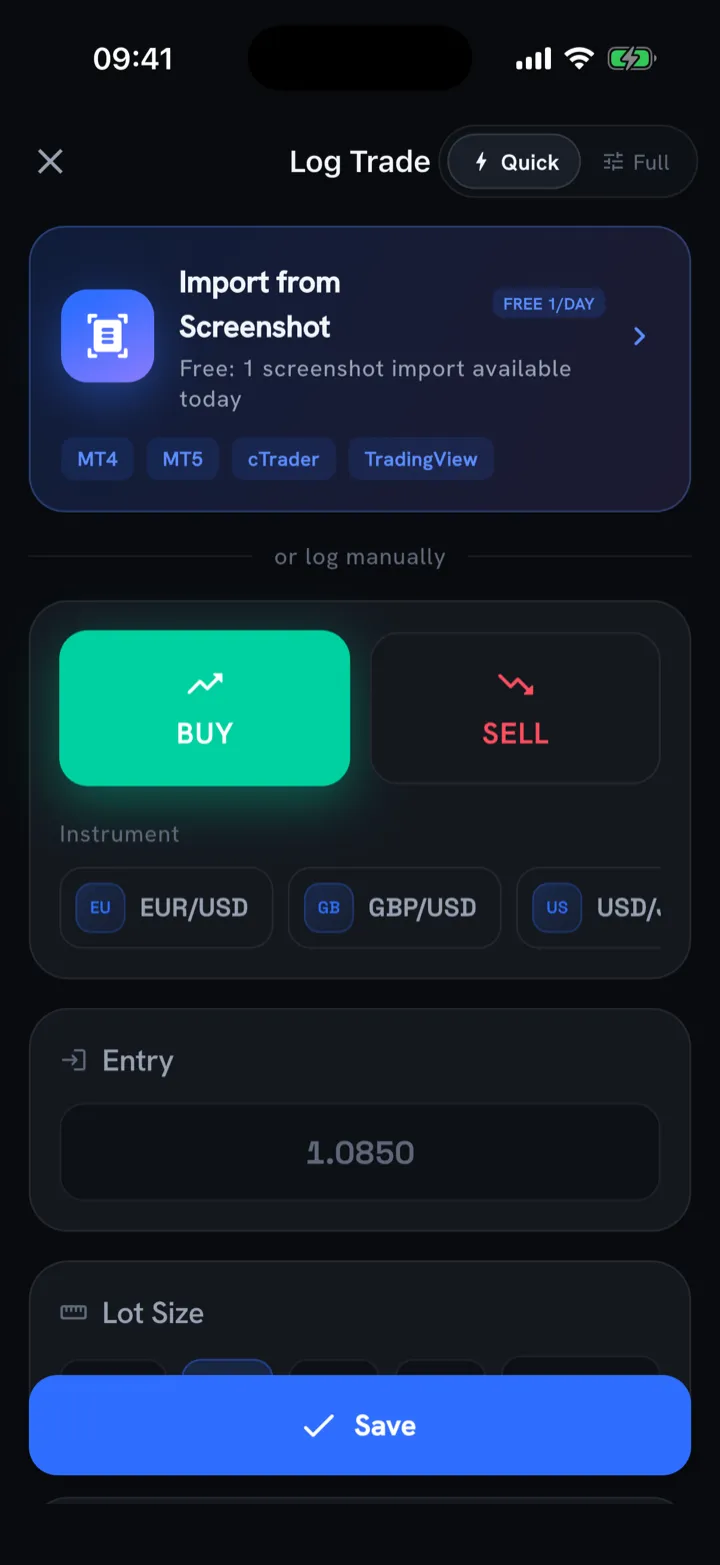
- Forex (lots): per-unit loss = stop in pips x pip value per lot. Size comes out in lots, often mini (0.1) or micro (0.01) lots for smaller accounts. If you bring fills in from a platform, screenshot import reads MT4, MT5, cTrader, and TradingView history, so your real sizes land in the journal without retyping. See how import works.
- Stocks (shares): per-unit loss = dollar distance from entry to stop. Size comes out in whole shares.
- Futures (contracts): per-unit loss = stop distance x the contract’s dollar value per point or tick. Size comes out in contracts, and you round down, since you cannot trade a partial contract.
- Crypto (coins or units): per-unit loss = dollar distance from entry to stop, same as stocks. Size comes out in units of the coin, which can be fractional.
In all four, you divide the same fixed dollar risk by what one unit loses at your stop. Learn it once and it travels across every market you touch.
Log the size and the stop, or you cannot audit R later
Calculating size correctly is half the job. The other half is recording it, because your analytics are only as honest as the inputs. The single most useful output of clean sizing is the R multiple: how many units of risk a trade returned. Risk $50 and make $150, that is +3R. Risk $50 and lose it, that is -1R.
R only works if every trade carries a recorded risk amount. If you log a win but not the size or stop behind it, you can see the dollars but never the R, and dollars alone hide whether you are improving or only betting bigger.
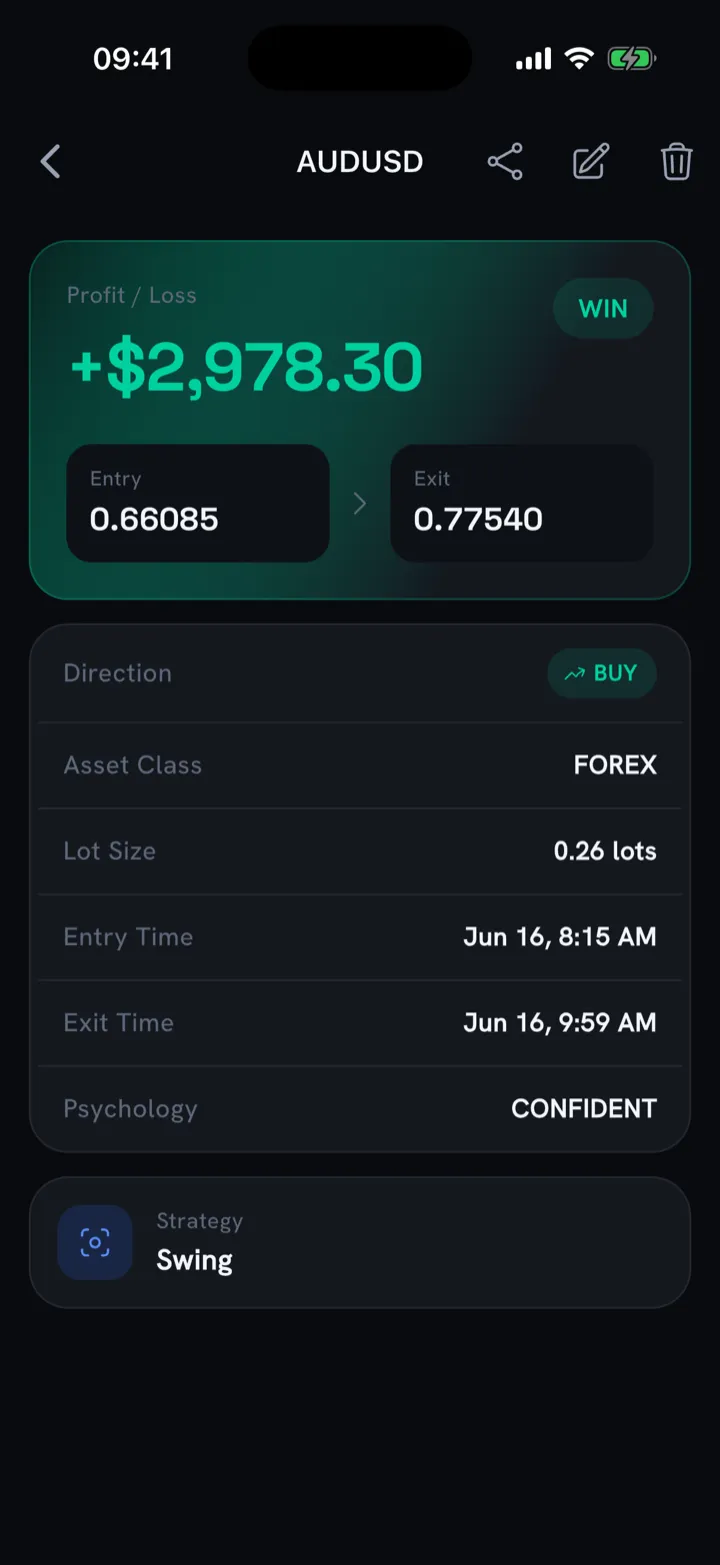
Once size and stop are stored on every trade, the metrics that matter start telling the truth: average win in R, expectancy per trade, the spread between your best and worst sizing. Pair that with a habit of logging every trade and you get the full feedback loop laid out in the trading journal guide. Skip the inputs and the dashboard is decoration.
How Trade Buddy keeps your R honest
Trade Buddy is built so this is the default, not extra work. When you log a trade you enter entry, stop, and position size, and the app computes the dollars at risk and the resulting R for you. Because risk is captured on every position, the analytics on win rate, average win and loss, expectancy, and drawdown are calculated against real risk instead of guesses, with plain-English explainers next to each number.
Your sized, recorded trades roll up into the PnL calendar so you can see the shape of your month at a glance, and your data stays on your device with no account required. It is free forever to start, and you can compare what the paid tiers add on the pricing page.
The bottom line
Position size is the one number that decides whether you are still trading next month. Set your dollar risk first, divide by what one unit loses at your stop, and let the size fall out of that. Same formula in forex, stocks, futures, and crypto, only the unit changes. None of this is financial advice, and sizing well will not hand you a winning strategy, but it keeps a bad trade from ending the game while you build one. Log the size and the stop on every trade so your R stays honest. Get Trade Buddy free on the App Store.
Frequently asked questions
What percent should I risk per trade?
Most consistent traders risk between 0.5% and 2% of their account on a single trade, and 1% is the common starting point. At 1%, ten losers in a row costs roughly 10% of your account, which is survivable. Pick a number you can hold to on a bad day, write it down, and size every trade against it.
What is the position size formula?
Position size equals your account risk in dollars divided by your stop distance per unit. Account risk is your balance times the percent you are willing to lose. Stop distance per unit is what one share, lot, or contract loses if the stop is hit. Divide one by the other and you get the size to enter.
Does position size change with my stop distance?
Yes, and that is the point. A wider stop means more loss per unit, so you size smaller to keep the dollar risk fixed. A tighter stop lets you size larger for the same risk. The dollar you risk stays constant while the number of units flexes to match where your stop sits.
How does Trade Buddy track position size?
When you log a trade in Trade Buddy you record entry, stop, and position size, so the app can show the dollars you risked and the R multiple the trade returned. That keeps your analytics honest. Win rate and average win mean little until risk per trade is consistent and recorded for every position.
Is calculating position size the same for stocks and forex?
The formula is identical, only the unit changes. Forex sizes in lots using pip value, stocks size in shares using the dollar stop distance, and futures or crypto size in contracts or coins. In every case you divide your fixed dollar risk by what one unit loses at your stop. The unit differs, the math does not.